This is a weekly reflection of the workshop starting from the second week.

Reflection
Creating and Hosting a Website
This week, we learned how to use cPanel website to build and bind a dedicated website, and the application of FileZilla. Although I can't fully understand the use of its software, I can use it when creating html code to build a website. My current understanding is that it can more easily mobilize files in the computer. The edited code file can be dragged directly into the software, and the website will be updated with it, instead of saving it to the file on the desktop.
Web Scraping
The learning in the third week has become more complex. To be honest, I was a bit confused. We have learned about the scraper function, which can more conveniently locate and collect data that you think is useful in a certain night's webpage. (I am not sure if I understand correctly) However, I still cannot complete the specific steps without a tutorial. This week, I used templates to make some improvements to my website, making it slightly more aesthetically pleasing.
Data and Data Analysis
This week is definitely a difficult week. We chose a simulated scenario to build a data set. Because I still don't understand the web scraping last week, this week's task is a bit complicated. I feel that this course is not easy for me. In the end, we chose to collect and analyze students' digital participation in school posts about mental health issues on X. Because our group was formed in a hurry, we couldn't keep up well with the progress of the course, the process of setting the topic and collecting data was was not very smooth, but perhaps this is a situation that a student will definitely encounter. I hope that I will become more and more familiar and smooth later.
Data Visualization
It's a bit of a disadvantage for us to need to visualize the data this week because we didn't collect a very large sample size in week 4. Our previous goal was to collect digital participation of college students on social platforms regarding mental health, but we found that there were actually very few students willing to make it public, and most of the related posts came from official accounts, and their interaction volume is not very high. Another problem I encountered was that I only knew how to use Excel at a basic level, so I was a little behind in the class progress. However, in the end I still completed a simple bar chart that visualized our data with the help of my group members, and I am very grateful to them.
Machine Learning
This week we learned to use a teachable machine to generate a simple model that allows the computer to recognize what we want it to recognize, whether it's an actual item or a person's expression, etc., and after I uploaded a certain amount of pictures to use as reference data, the model did recognize it somehow correctly. But after several attempts, I found that artificial intelligence is still not as powerful as humans, because some objects may not be recognized just by changing the background. Artificial intelligence is still not able to perceive the full diversity of the real world, indicating that it is still not perfect and intelligent enough. This lesson made me realize more intuitively that artificial intelligence still has some limitations.
Identity, Algorithmic Identity, and Data
This week we've looked at how accurate our algorithms are about us, how the data is summarized, and what we can do to mislead the algorithm's inferences. I feel that a large part of algorithm comes from the personal information we actively enter when using the software and the length of time we stay in posts on certain topics. We also collected the topics of the last 15 posts from 32 of our friends on social media platforms to see if we could figure out people's preferences from their posts, and after analyzing them and my knowledge of some of them, I concluded that perhaps what people post on social platforms may be what they want people to see, and sometimes it is not their true self. Algorithms may not be able to accurately capture people's preferences if they just try to calculate from that aspect.
From Social Media Analytics to Digital Ethnography
This week we analyzed the categories of posts posted by 32 friends collected last week. I made a table by gender and found that men would forward some content in the category of politics or news, while women would post content in the category of ideas or reflections. The distribution of other categories was relatively even, which I found quite interesting. However, it cannot be said that men will pay more attention to politics and women will not. It can only be said that these friends I analyzed may be like this. We also communicated in pairs in class about the communities we participated in, and through our discussions I think it's very important to have the help of people in the community that you want to study, otherwise you're going to feel a little bit lost. No matter what community it is, we should treat it from an objective perspective, because you can not control the community in what people publish content, it is best to put yourself in a position of observer to avoid some unnecessary trouble.
Interactive Narratives
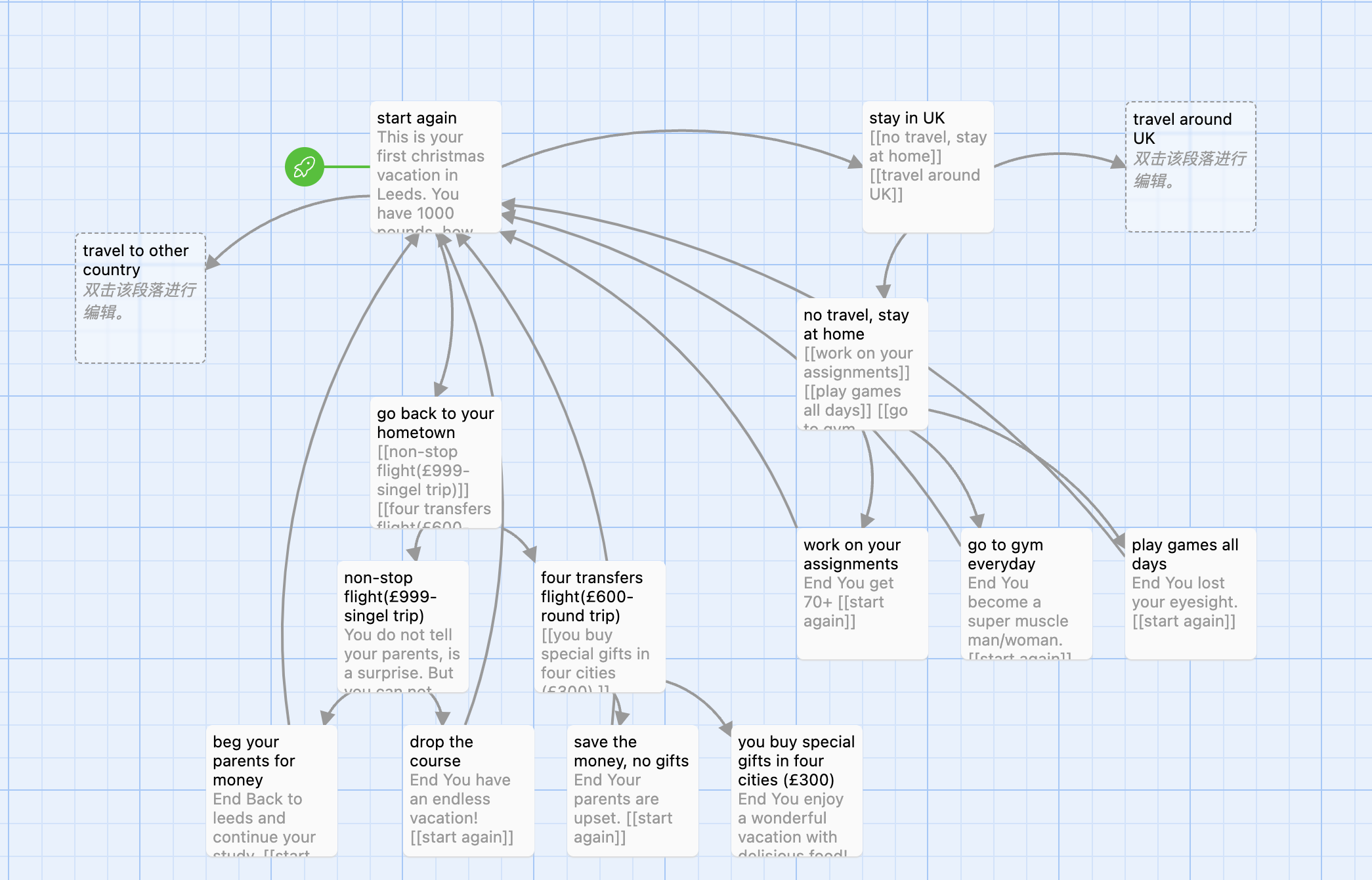
In the last week of the digital practice workshop, we took interactive narratives, which can also be called electronic stories. Through textual prompts, we clicked step by step to delve into the development of the story, which had different narrative paths leading to different outcomes. Although the interaction is mainly achieved through the promotion of text content, there is not much text in each path. I think this prevents us from closing the game due to lengthy and difficult to understand content, and also encourages my desire to continue clicking. We also used Twine to create simple interactive stories based on our experiences in Leeds in groups or individually (the sceenshot is attached at the end). I think this not only allows us to learn how to use words to create a playable story, but also has a good enhancing effect on divergent thinking. Twine
Massa libero
Nullam et orci eu lorem consequat tincidunt vivamus et sagittis libero. Mauris aliquet magna magna sed nunc rhoncus pharetra. Pellentesque condimentum sem. In efficitur ligula tate urna. Maecenas laoreet massa vel lacinia pellentesque lorem ipsum dolor. Nullam et orci eu lorem consequat tincidunt. Vivamus et sagittis libero. Mauris aliquet magna magna sed nunc rhoncus amet pharetra et feugiat tempus.